
Herniated Disc and Cervical Radiculopathy: A Different Way to Think About Spinal Pain
The MRI shows it clearly - a disc is bulging, herniated, or degenerating. It's pressing on a nerve root, causing the radiating arm pain, the neck stiffness, the numbness in the fingers. Or the lower back version: the disc pressing on the nerve that sends pain down the leg. You have a diagnosis. What you may not have is a clear path forward that doesn't involve surgery or long-term pain management.
Spinal disc pathology is one of the most common reasons people come to Tom Eddins at Whispering Waters Wellness in Boone. And it's one of the conditions where the gap between what imaging shows and what a person actually experiences is most dramatic - in both directions. Some people have significant disc herniation with minimal symptoms. Others have moderate findings on MRI but debilitating pain. The disc is not the whole story.
What's Actually Happening with a Herniated Disc
The intervertebral disc is a hydraulic structure - a fibrocartilaginous ring called the annulus fibrosus surrounding a gel-like nucleus pulposus. Its primary jobs are to distribute compressive load across the vertebral segment, provide mobility between vertebrae, and protect the neural structures exiting the spinal cord at each level. Disc health depends on hydration, nutrition delivered through endplate diffusion, and the mechanical integrity of the annular fibers.
In the cervical spine, this produces symptoms into the arm and hand. In the lumbar spine, it produces the pattern commonly called sciatica.
But mechanical compression is only part of the picture. The inflammatory response to disc herniation, mediated by pro-inflammatory cytokines including TNF-alpha, IL-1beta, and IL-6 released by the nucleus pulposus material, produces significant chemical irritation of the nerve root independent of the mechanical pressure. This is why nerve root pain from disc herniation often far exceeds what the degree of compression alone would predict, and why reducing inflammation is as important as addressing mechanical load.
Cervical Radiculopathy Specifically
Cervical radiculopathy, nerve root compression in the neck, most commonly affects C5 through C8, producing distinct patterns of radiating arm pain depending on the level involved. C5 compression produces pain at the outer shoulder and upper arm. C6 affects the lateral forearm, thumb, and index finger. C7, the most commonly affected level, produces pain through the triceps region and into the middle finger. C8 compression involves the medial forearm and ring and little fingers. These patterns are useful diagnostically and guide where treatment is focused.
Cervical discs are additionally affected by the forward head posture that has become almost universal with screen use. Looking downward just ten to fifteen degrees puts the head in a position that dramatically increases compressive load on the lower cervical discs and chronically shortens the posterior cervical musculature and suboccipital region. Addressing posture and the muscular patterns that maintain it is inseparable from treating cervical disc pathology effectively.
Why Conservative Care Often Plateaus
The standard conservative care path for disc herniation - rest, anti-inflammatories, physical therapy, epidural steroid injections - helps many people significantly. The question is why it plateaus for others, leaving residual nerve pain, stiffness, and functional limitation that persists long after the acute injury phase should have resolved.
The most common reason is incomplete treatment of the neural component. Physical therapy addresses the muscular stabilization and movement patterns around the disc and is genuinely important work. But it doesn't directly reduce the sensitization of the nerve root that has been chemically and mechanically irritated. A nerve root that has been compressed and inflamed for months develops its own pain-generating capacity through upregulation of sodium channels and changes in dorsal root ganglion signaling - changes that persist even after the mechanical compression is reduced. Treating the nerve's own sensitization requires a different approach than treating the structural problem that irritated it.
Epidural steroids address the inflammatory component effectively in the short term but carry risks with repeated use and don't address the disc's own healing capacity or the nervous system's sensitization. And neither standard PT nor injections address the internal terrain factors: systemic inflammation, circulatory quality, tissue hydration. These are the factors that determine whether the disc and surrounding structures can actually repair themselves.
How Acupuncture Approaches Disc Pathology and Radiculopathy
Reducing Nerve Sensitization Directly
Acupuncture applied along the affected nerve root pathway - both at the spinal level and distally along the nerve's course into the arm or leg - modulates the dorsal horn sensitization that maintains radicular pain. Electroacupuncture at specific frequencies activates mu-opioid receptors at the spinal cord level, reducing the amplified pain signaling that characterizes chronic radiculopathy. This is distinct from, and complementary to, what physical therapy and injections accomplish. It directly addresses the neural component that often explains why residual pain persists after structural treatment has been completed.
Tui Na for Cervical and Lumbar Disc Pathology
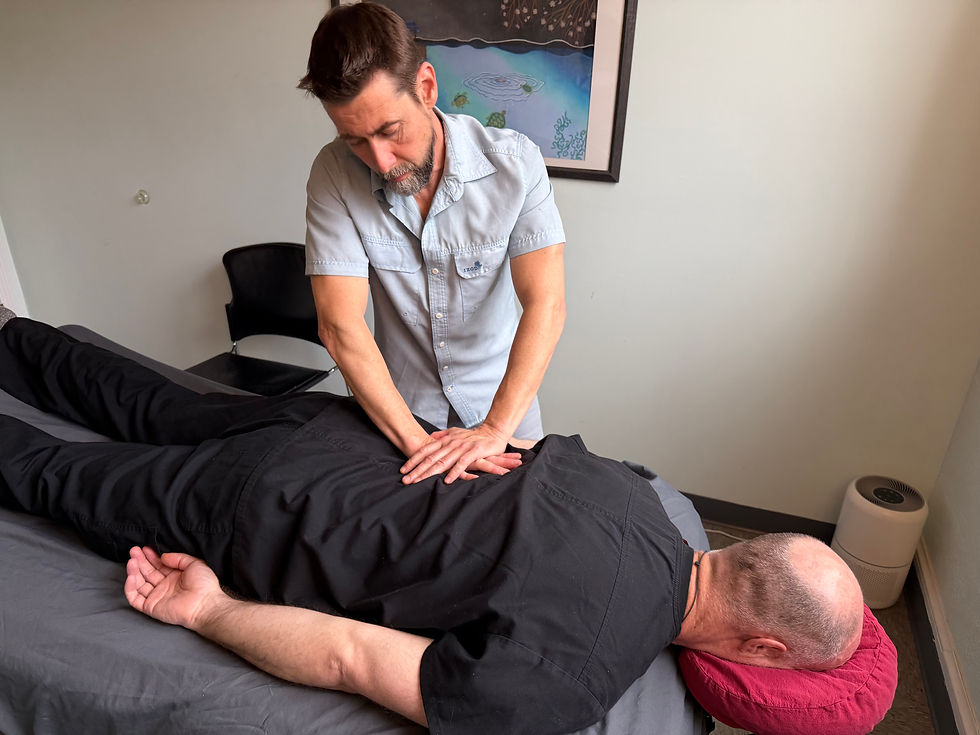
Tui Na orthopedic bodywork addresses the muscular and fascial components that standard treatment often underemphasizes. In cervical radiculopathy, the scalenes, levator scapulae, and suboccipital muscles are almost always involved, becoming shortened, hypertonic, and contributing to the compressive load on the cervical discs. Releasing these tissues manually reduces the mechanical stress on the affected disc levels and restores range of motion that has been lost to protective muscle guarding. For lumbar disc pathology, the quadratus lumborum, psoas, and deep paraspinal muscles require similar attention. Tom's approach to soft tissue release around the spine is a core part of what makes disc treatment at Whispering Waters different from acupuncture alone.
The Internal Terrain - Disc Healing from the Inside
In Chinese medicine, the spinal discs fall under the domain of the Kidney system, which governs bone, nerves, and the structural integrity of the spine. Kidney system deficiency, a pattern associated with aging, chronic overwork, and systemic depletion, corresponds clinically to reduced disc hydration and resilience, poor bone density, and impaired capacity to repair spinal structures under load. Addressing this systemic pattern through acupuncture and herbal support changes the internal environment in which the disc exists, improving the microcirculation that delivers nutrients to disc tissue through endplate diffusion, and supporting the body's own reparative processes at a level that purely structural treatment cannot reach.
What to Expect for Disc and Radiculopathy Treatment
Acute disc herniations - recent onset, significant nerve root compression - respond more rapidly than chronic, long-standing radiculopathy. Acute cases often see substantial improvement within six to eight treatments. Chronic radiculopathy, particularly cases where nerve sensitization has been established over months or years, typically requires twelve to twenty sessions to achieve lasting relief.
In cases with significant neurological deficits - progressive weakness, loss of sensation, or any bowel or bladder involvement - surgical evaluation is always recommended concurrently. Acupuncture can be a valuable complement to surgical preparation and recovery, but it does not replace the structural intervention that severe nerve compression sometimes requires. Tom will be direct with you about this assessment from the first visit. Lifestyle factors - posture, sleep, diet, and movement habits - are also addressed as part of every disc treatment plan, since these directly affect the disc's healing environment between sessions.
Common Questions About Disc and Nerve Pain
My MRI shows significant disc damage. Can acupuncture actually help, or is surgery inevitable?
Imaging findings and pain experience frequently don't correlate the way people expect. Significant disc herniation on MRI is common in people with no symptoms at all, and moderate findings on imaging can produce severe symptoms in others, depending on the degree of nerve sensitization and the inflammatory environment around the nerve root. Acupuncture cannot reposition a herniated disc mechanically, but it can substantially reduce the nerve root's sensitivity to the compression, decrease the inflammatory cascade driving chemical irritation, and support the disc's own capacity to resorb and heal over time. Research shows that a significant proportion of lumbar disc herniations undergo spontaneous resorption within six to twelve months... the question is whether the pain can be managed conservatively during that window. Many patients who were told surgery was likely have avoided it through a consistent course of conservative care that included acupuncture. Surgery becomes clearly indicated when there are progressive neurological deficits - worsening weakness, numbness, or bowel and bladder involvement. In the absence of those findings, a thorough trial of conservative care is almost always worth pursuing first.
I had neck surgery and still have arm pain. Can acupuncture help post-surgical radiculopathy?
Post-surgical persistent radiculopathy is a real and frustrating clinical situation, and one where acupuncture often provides relief that further surgical intervention cannot. The most common reason for persistent nerve pain after anatomically successful spinal surgery is ongoing central sensitization - the nervous system's pain-generating adaptations that developed during the period of nerve compression and that don't automatically resolve when the structural problem is corrected. Scar tissue formation around the nerve root can also contribute. Acupuncture and electroacupuncture directly address central sensitization through the same descending pain inhibition mechanisms relevant to pre-surgical radiculopathy. Post-surgical cases also benefit significantly from the Tui Na work addressing the muscular compensations that develop around a surgical site. These cases take time and consistency, but the response is often meaningful in people who have been told nothing more can be done.
Considering Your Options for Disc and Nerve Pain?
A free consultation is the right first step. Tom will review what you're dealing with, what you've already tried, and give you an honest assessment of what acupuncture and Tui Na can realistically accomplish for your specific situation. Learn more about Tom's approach to chronic pain or call and text (828) 773-5032. Located at Peak Chiropractic, 136 Furman Road, Boone, NC 28607.

Comments